
Good morning from New Economy Brief.
“Breathing space for today, hope for the future” was the promise of John Healey’s first Budget as Chancellor. But did it match the government’s pledges to break from neoliberalism and rebuild the state?
There was help with energy bills, new public investment and modest tax rises. Yet 98 policy changes amounted to just 0.5% of the additional spending in Reeves’s first Budget. This week’s digest looks at how battles on energy support, tax and defence all resolved in the direction of minimal change.
Who pays for the energy shock from the Iran war?
The main cost-of-living measures are a one-off £100 payment for households in council tax bands A-D in England, extending the earlier electricity VAT cut to take £50 off the Ofgem price cap in April 2027, and abolishing gas standing charges, with costs shifted into unit rates. The Treasury’s Budget summary sets out the package.
There is a political logic to paying money directly into bank accounts. As the Observer’s Ben Zaranko observed, it should make support more visible. But visibility is not the same as effective targeting. The Resolution Foundation found that barely half the package benefits the poorer half of households, and that typical household bills will still rise above the level reached during the 2022-23 energy crisis, when the government introduced the more universal Energy Price Guarantee. Its summary highlights the wider squeeze on living standards.
The Treasury was likely wary of the costs of universal intervention, and of allowing the 2022 measures to become a precedent every time there is an inflationary shock. Yet it has also struggled to develop more effective forms of targeting. The result is neither universal, nor generous, nor well-targeted. The New Economics Foundation has argued that a national energy guarantee would have protected households better.
There is a longer-term cost, too. The Budget cuts at least £1bn from the £15bn Warm Homes Plan, along with £720m from the Boiler Upgrade Scheme, £180m from low-income schemes and £100m from heat networks. That means less money for improving energy efficiency and reducing households’ exposure to future price shocks. These cuts helped fund gaps in the Defence Investment Plan; reports that the Boiler Upgrade Scheme struggled to spend all of its allocation may also have made it an easier target.
The banks, landlords and other vested interests?
The bank surcharge will temporarily double from 3% to 6% for 15 months, raising £1.5bn for household energy support. Tax on property and savings income rises by two percentage points from April 2027, while gambling companies and online retailers face higher taxes.
But the measures fell short of campaigners’ hopes. As Chris Giles noted in the Financial Times: “£1.5bn over a 15-month run is not a lot of money.” Banks may have lost the immediate tax battle but won the wider argument over how much they should contribute.
The government also rejected capital gains tax reform and National Insurance contributions on partnership income – changes advocated by Tax Justice UK. The question is why it has been so cautious about asking those with the greatest capacity to contribute to a larger response to the cost-of-living crisis.
Part of the answer is the desire to establish fiscal credibility and avoid higher borrowing costs. In a time of global turmoil for government borrowing, the gilt market has remained broadly stable after the Budget, despite the government borrowing slightly more and slowing the pace of their deficit reduction plans. Evercore ISI’s Krishna Guha called the package “less bad for banks than feared” and said there was little in it to add significantly to inflationary pressure.
The reluctance to reform capital gains tax may also reflect concern that the OBR would not score the revenue as highly as campaigners expected. Ministers may have felt the hope this would increase tax receipts over time wasn't enough to justify running the risk that the OBR would cut its much-reported 'headroom' calculation.
But is the cautious approach truly fiscally responsible? Could stronger action to reduce energy costs and support household incomes help tackle the inflationary pressures that raise borrowing costs in the first place? The Treasury still appears unconvinced that universal interventions to prevent price spikes can themselves be a credible fiscal strategy to bring down interest rates and gilt yields.
The Martin Lewis Budget – not the Burnham Budget
The Budget’s modest scale jars with the new government’s rhetoric. In his Guardian column, Aditya Chakrabortty called it a “Martin Lewis Budget”: small practical fixes to everyday irritations. “What’s the point of cut-price marmalade when a few months ago you promised to nationalise Thames Water?”
The £100 payment and changes to gas standing charges will help some households. But they fall well short of the promise to end 40 years of neoliberalism. As Martin Lewis himself has warned, “there are too many people who can no longer help themselves and it is time for structural change.”
The big decisions remain deferred, as does fiscal consolidation. Who will bear its burden: households already struggling with bills, public services facing real-terms cuts, or those with the greatest capacity to contribute?
The pressure on public services is already significant. The IFS says spending plans look extremely tight, while the Resolution Foundation highlights how inflation and debt interest are eroding fiscal space. The Milburn review of young people outside work and education, Timms review of disability benefits and Casey Commission on adult social care will inform decisions still to come. Details of how defence spending will reach 3% of GDP by 2030 have been pushed into the 2027 Spending Review.
The Budget has bought the government some breathing space with households and financial markets. But it has not yet answered the bigger question: how will a government promising to rebuild the state find the resources to do so? As a reminder, its big commitments include expanding council housebuilding, increasing public control over essential utilities and reindustrialising the country.
The government could use its forthcoming 10-year plan to rethink the fiscal framework and unlock more investment, as IPPR has argued. In the longer term, it is unlikely to be able to balance all its commitments without tax reform, which could also make the tax system fairer and more efficient.
For now, the government has reassured markets and deferred the big arguments. But small fixes cannot substitute indefinitely for the structural change Burnham promised. The next Budget must show how the government intends to change the economic conditions that make life so difficult in the first place.
Stat of the week
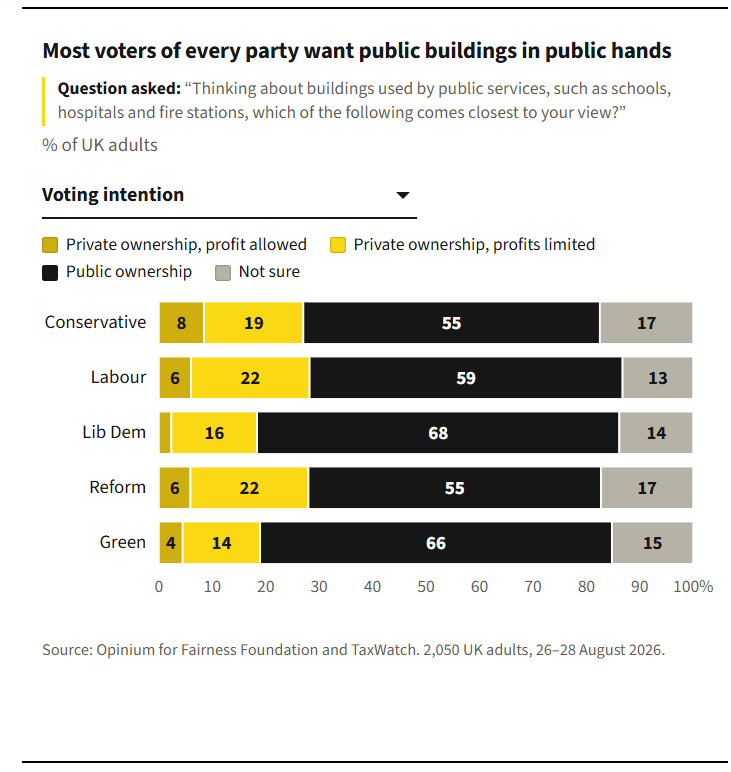
Source: TaxWatch and the Fairness Foundation
An Unashamedly Female Agenda: A Political Economy for Women. Women's Budget Group and the Good Growth Foundation published an essay collection calling for women’s engagement in the economy at the heart of Labour’s economic and industrial strategy. They calculated that the economy is missing out on £133bn due to unequal pay and work terms between genders. The collection features essays from Labour MPs such as Sarah Russell, Emily Darlington, Anna Dixon, Maya Ellis and more
Fiscal Rules and Long-Term Inclusive Growth. Hosted by the Spanish government and supported by UCL IIPP, The Global Council on New Economics for the 21st Century have published a briefing on the case for reforming fiscal policy, rules and the definition of fiscal responsibility. It has been written by academics and policymakers including Carlos Cuerpo, Mariana Mazzucato, Jayati Ghosh, Ha-Joon Chang, Joseph Stiglitz, Isabella Weber and more.
“We need an inflation-fighting toolbox that stabilises the prices of essentials”. Economist Isabella Weber has an article in the FT explaining why inflation and the loss of economic security has political consequences, and why higher interest rates exacerbate the problem. (Read our previous New Economy Brief on How improving household incomes can stop the far right for more)
Against Bond Vigilantes: Reclaiming UK Fiscal Space. Mainstream has published a report from economist Daniela Gabor arguing for monetary and fiscal policy reforms to prevent bond investors reducing the government’s fiscal space. She proposes a new coordination framework between the Bank of England and the Treasury, redirecting pension savings into a Public Essentials Fund and replacing inflation-linked gilts with conventional gilts.
The Extreme Weather Levy. Verdant has calculated an extreme weather levy could raise £6.5bn to help cover costs of climate damage and adaptation. The levy charges fossil fuel assets and rises when triggered by an extreme weather event, such as Storms Austen and Boelo which left over 800,000 UK properties without power.
The Parliamentarians’ guide to health and climate change. Peers for the Planet have published a briefing explaining why climate change is a public health threat to the UK, covering areas like extreme heat, air pollution, extreme weather, food security, the economic costs of these health risks, how to adapt to them, and more.

